Julia Sayles has learned a lot about coffee prices this year.
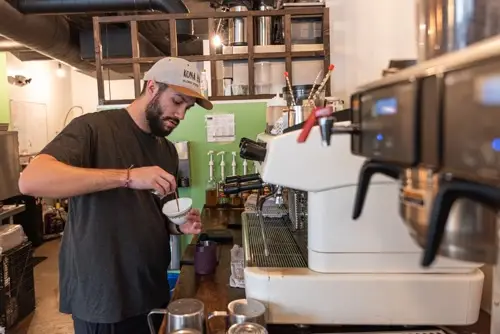
Her company, called Kindred Coffee, opened in August. She offers a mix of drinks from the back of a specially designed trailer – a business location chosen because of the lower overhead needed to break into the local scene. She has catered events, served at markets and plenty in between.
There’s just one problem.
“I quickly realized I’m actually not making enough money,” Sayles said.
A major culprit, she explained, is the cost of the coffee itself. Since hitting the local market, Sayles said the price of the roasted beans she’s buying has jumped by about $2 per pound.
She doesn’t use as much coffee as many of her competitors, but at 10 to 15 pounds per week, those price changes add up. And there are other prices to consider, as well.
The average coffee shop owner has to pay for beans, syrups, milks and even the coffee cups themselves.
Within months of opening, she’s already had to raise her prices. Now, with more events under her belt and a better understanding of the local market, she’s feeling steadier. Although she’s still in the “paying things off” phase, she’s making enough to cover operating expenses.
Sayles works another job on the side. But if she ever wants to open a brick-and-mortar store, she said, she needs to find a niche. Blount County has 25 coffee shops and a few coffee trailers, each competing to attract their own slice of the local clientele.
To find her own spot, Sayles is leveraging social media marketing and even paying a little more to change the shape of her cups in an effort to “go viral” through online connections. Every time a customer posts a photo of her cups online, she said, it’s free advertising for the business.
Her process is working well – most of her bookings come from social media. But as costs continue to rise, she may need to reassess prices yet again.
Global Issues Affect Local Prices
Tosha Wilhelmsen has operated Southern Grace Coffee Co. in Maryville for about a decade. The business roasts and sells beans, offers a mix of coffee and tea-based drinks and also sells baked goods with a gluten-free focus. But over the past several years, Wilhelmsen said she’s seen a steady rise in the price of green, unroasted beans.
In the coffee business, volatile prices are a fact of life. Two years ago, Wilhelmsen was paying about $4 per pound for beans. In 2025, she saw prices around $6.
Those prices reflect national trends recorded by the Bureau of Labor Statistics, and according to the National Coffee Association, “There is no single reference for the global market price of coffee. But
the commonly-referenced green coffee price has hit record highs over recent years due to decreased supply that diminished previously large global coffee surpluses, as well as other factors.”
Essentially, there isn’t as much extra coffee in the system as there used to be. Coffee demand is on the rise and production is up globally. But the U.S. Department of Agriculture reports that global coffee stockpiles are expected to drop for the fifth year in a row in 2026. Analysts point to poor production years in Brazil, among several other sources, thanks to unpredictable elements like heat and rainfall.
Less extra coffee means more competition for what remains – no matter the source nation.
Despite those trends, it’s impossible to pin rising coffee prices to just one factor. Andrew Muhammad, an economist with the University of Tennessee Department of Agricultural and Resource Economics, said the market usually isn’t quite so simple.
Widespread tariffs implemented in 2025, for example, have likely affected U.S. coffee imports. Those added import charges, Muhammad said, are often passed on to consumers.
Therefore a hefty added tariff on Brazilian imports to the United States, Muhammad said, “isn’t helping an already bad situation.”
As of early 2026 there was no longer an added tariff on American coffee imports, although the Associated Press reported in November that Brazilian prices may remain high for retaliatory reasons). High price tags can stick around longer than their causes. Coffee beans roasted, ground and placed on store shelves must cover the cost it took to get them there – and that means prices at the grocery store often lag behind production and import costs.
As new beans come in, prices may go down.
Bringing it home
Some local roasters may already be seeing that happen. Although her coffee costs have spiked for years, Artistic Bean owner Lauren Snodgrass said she’s seen a drop in recent green coffee costs. So has Wilhelmsen.
It hasn’t been much – a dollar or so per pound at most – but both local business owners said the reduction was a welcome reprieve from regular price increases.
Snodgrass has had to think carefully to keep the business steady recently. She and her husband bought the Townsend-based roaster and coffee shop in 2023. They’ve worked to emphasize quality, free-trade coffee beans in their drinks. In mid-2025, she opened a second location on Old Knoxville Highway, anticipating increased demand in the Eagleton Village area thanks to development on Pellissippi Place.
She’s seen $2 to $4 price increases per pound in recent years. That may not look like much, but the pennies add up after a 1,000-pound order. The change for her business has meant thousands of dollars in added costs.
Because of that, she’s had to analyze her labor costs and find ways to save money while still keeping her 14 employees happy and healthy. She and her husband have both worked shifts at the shops to save money.
“Our supplier said just from projections that [the price of coffee] is on a downward trend, so hopefully in the next month when we have to order it’ll be even less,” she said. “As long as it’s not going up, I think we can sustain what it is at current prices.”
The new location has been “slow growth” but enough to keep itself going. And thankfully, the costs of Snodgrass’ other materials — cups, lids, milk and syrups – have been remarkably steady.
For her part, Wilhelmsen said she’s been bundling her orders to save money as prices rise. Although her recent orders have dropped in price, they still haven’t recovered to where they were years ago.
They’re closer to late-2024 prices, she said.
Wilhelmsen is no stranger to thinking outside the box to keep her business steady. Southern Grace survived the COVID-19 pandemic largely thanks to customer dedication and staff ingenuity. Seeing the community developed from her business, Wilhelmsen said, has made the work worth the effort.
She thought Southern Grace would create a community for young mothers. What she’s seen has surprised her. Sometimes the clientele is young mothers as expected. Sometimes it’s a group of men holding a Bible study, she said, and other days the store is full of teenagers.
“A coffee shop equals fellowship and family,” she said. “And it’s beautiful.”
Whether that community remains affordable depends on forces largely outside a shop owner’s control. If coffee prices continue to ease, Wilhelmsen said, she may finally have room to roll back prices for customers.
In the meantime, local coffee businesses, as always, are adjusting their models with an eye toward maintaining both affordability and long-term sustainability.